

Guy Vandenbranden
The architect of silence
Guy Vandenbranden is a key figure in post-war Belgian abstraction: an artist of order and clarity. Where others expressed emotion through color, he found emotion in precision. He turns geometry into a form of poetry, cold in structure, warm in spirit.
Man
Guy Vandenbranden was born in Brussels in 1926 and died in Antwerp in 2014. He started out as a figurative artist, but in the mid- 1950s he made a radical shift towards geometric abstraction.
His art is characterized by discipline and rhythm. No grand gestures, but dedication. He is a man of thought and feeling, of silence and precision.
Moment
In the years after World War II, European artists sought new ways to depict reality. Guy Vandenbranden found the answer in clear, austere forms.
In the early 1950s, Vandenbranden began experimenting with free, abstract painting. From then on, he worked exclusively with geometric forms, a style to which he remained faithful for the rest of his career.
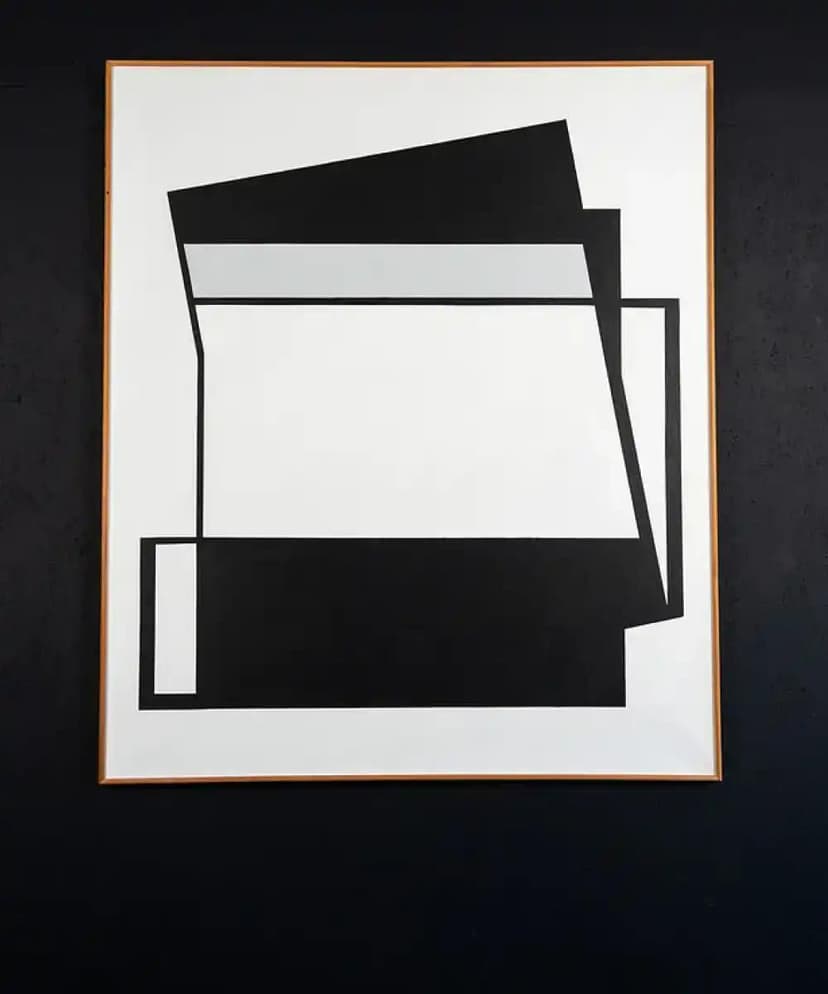
In the late 1950s, Vandenbranden mainly used black and white. His works became almost entirely monochrome and were in line with the austere style that was also popular in the United States at the time, known as Hard Edge. From 1961 onwards, he added depth and relief. In the 1960s, he used a spraying technique to apply lacquer paint to panels. In this way, he created optical effects and illusions, related to Op Art.
Matter
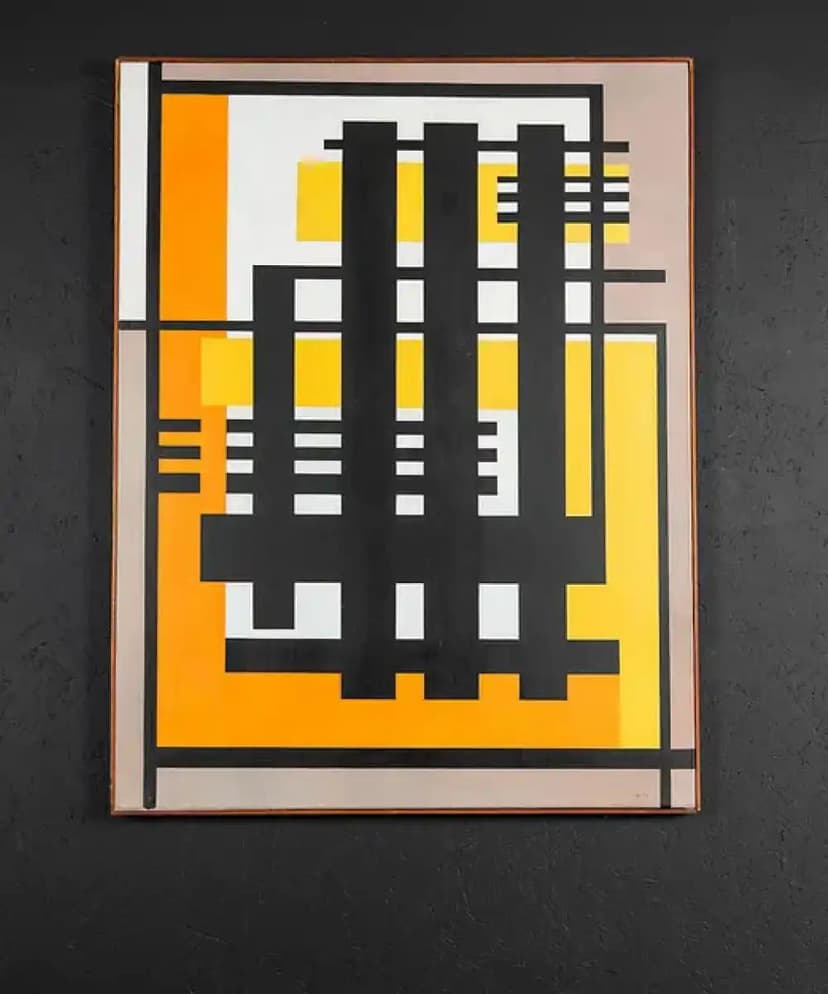
His paintings are meticulously constructed. Beneath the precision of the lines and planes lies emotion: the desire for peace, balance, and order in a chaotic world.
His compositions have a musical structure: repetition, contrast, and rhythm. They appear cool, but vibrate with inner tension. He painted the silence between forms.
What is his greatest contribution to art history?
Guy Vandenbranden gives geometric abstraction a soul. He proves that pure form does not have to be a cold formula, but can evoke a meditative experience.
He anchors Belgian abstract art internationally and gives it its own identity: austere, clear, but human.
Can we consider him a master?
Of course. Vandenbranden is a Flemish master of silence and line. His work embodies a typically Belgian form of modernity. He is internationally regarded as one of the most important representatives of Belgian abstract art.
A work by him in every household?
Yes, a painting by Vandenbranden provides moments of calm. They are places where the eye can breathe and the mind can slow down. A Vandenbranden in your home is not decoration, but a silent compass that points the way to tranquility. They remind us that beauty does not always lie in abundance, but often in limitation, repetition, and structure.
He teaches you to look as you would listen: attentively, gently, and precisely.